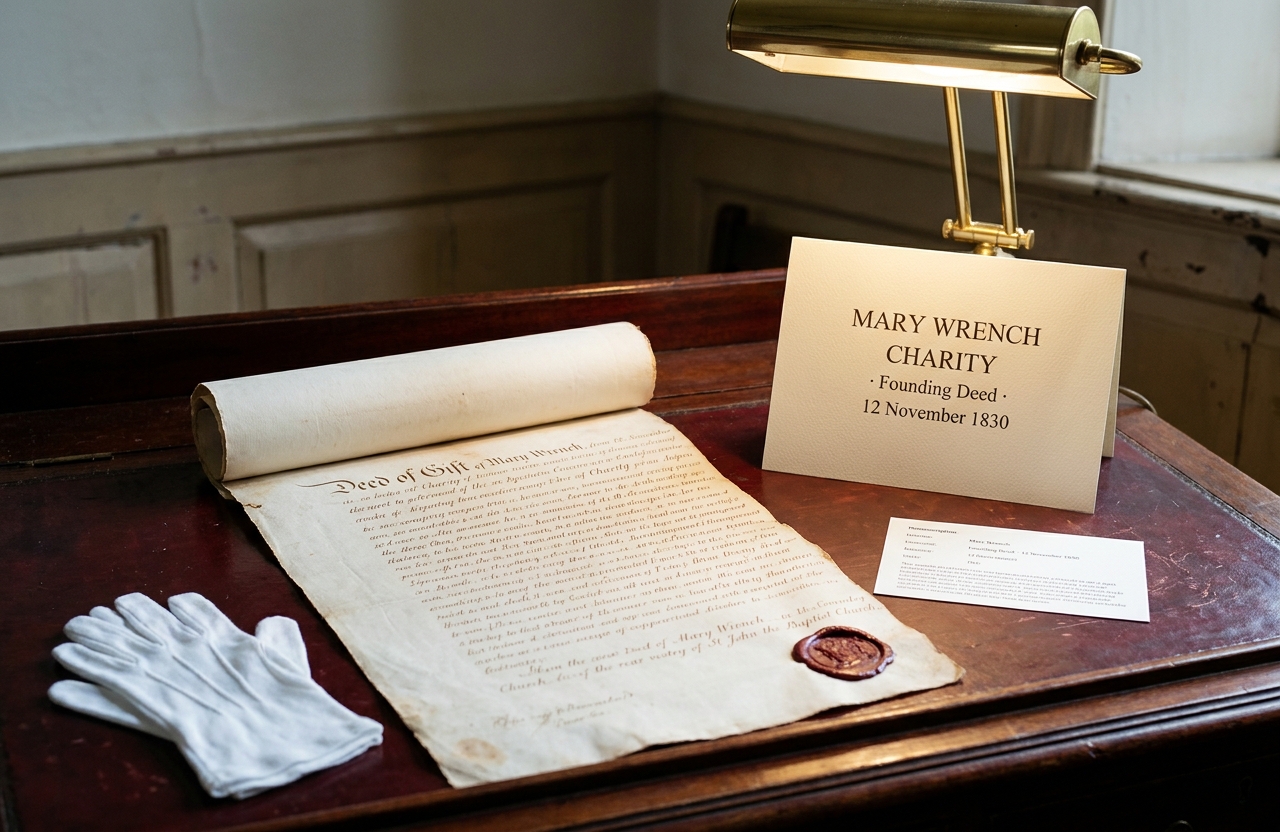
There is a particular pleasure in reading a 1830s deed by 2020s daylight. Mary Wrench's gift document is not long — a single sheet of vellum, perhaps fourteen inches by twelve, with copperplate ink lines that have gone an even cocoa-brown over time. The handwriting is, on close reading, the clerk's; the signature at the bottom right corner is the testatrix's own, and is rounder, slower and a little less practised than the body of the document.
The deed sits at the Cheshire Archives at the Cheshire Record Office in Chester, under the reference DSO/12/MW/1830. The trustees took the deed to be conserved in 2007, after a small water incident in the vestry cupboard, and it has been kept there since on a five-yearly review. The Archives kindly permit us to lift it for photographs once every two or three years; the rest of the time we work from a 2007 facsimile, kept on the parish desk and slipped behind a sheet of acid-free interleaving.
What follows is the deed read in plain modern English, clause by clause, as the trustees of today understand it. The original wording, where it bears reading, is given alongside in italic.
Clause one · the gift itself
Plain English: Mary Wrench, of Knutsford, gives to three named trustees of the parish a parcel of land lying behind the cottages at the Lily Pool, together with the sum of forty pounds in cash, to hold for the benefit of the poor of the parish.
'I, Mary Wrench, of the said parish of Nether Knutsford, spinster, do by these presents grant unto the said Trustees, their successors and assigns, all that piece or parcel of land lying behind the cottages at the Lily Pool, with the sum of forty pounds of lawful money …'
The land at the Lily Pool was sold by the trustees, with the Bishop of Chester's consent, in 1843 for £112, and the proceeds were invested in a small consol that still produces an annual dividend, although a smaller one than it once did. The £40 cash sum — about £4,500 in today's money, though such conversions are misleading — was spent on grants within the first decade.
'For the general benefit of the poor of the said ancient parish of Nether Knutsford for ever, without distinction of persuasion.'Mary Wrench · Deed of Gift · clause two · 12 November 1830
Clause two · the purpose
Plain English: The gift is to be used for the general benefit of the poor of the ancient parish of Nether Knutsford, for ever, without distinction of religious persuasion. (This is the famous sentence; this is what we read out at trustee meetings when we are uncertain.)
'… for the general benefit of the poor of the said ancient parish of Nether Knutsford for ever, without distinction of persuasion …'
The phrase 'without distinction of persuasion' is striking. The Anglican parish would have been the dominant religious establishment of 1830s Knutsford, but the town had a long history of nonconformist worship — Wesleyan, Unitarian, Quaker — and Mary Wrench was almost certainly aware of it. By writing those four words, she committed the trustees of every generation since to help anyone within the parish, of any faith or of none. The trustees have given grants to Roman Catholic families, Jewish families, Muslim families and to people of no religious belief. The deed has been our authority.
Clause three · the trustees
Plain English: Three trustees are named in the deed itself, with provision that, on the death or removal of any one of them, the parochial church council of St John's, Knutsford, shall appoint a successor in consultation with the Rural Dean. Trustees serve as such and not in their personal capacity, and may not take payment from the trust for any service.
'… and upon the death or removal of any of the said Trustees, the Parochial Authorities of the said parish shall appoint such successor as they deem fit, with the advice and consent of the Rural Dean of Knutsford …'
This clause has been the most-amended part of our practice. The original deed assumes a single Anglican parish with the Rural Dean as a senior figure; modern church governance has evolved, and we now read this clause as requiring the consent of the Knutsford Deanery in the Diocese of Chester. The five-year renewable term we observe is not in the deed itself but was adopted by minute in 1987 to ensure a regular turnover of trustees.
Clause four · what trustees may not do
Plain English: The trustees may not give the trust's funds to themselves, to their relatives, or to any commercial venture, political campaign, or religious mission. They may make grants only to individuals or, with caution, to a parish-bound institution that passes the help on to families. The trustees may not assist anyone outside the ancient parish boundary.
This is the boundary clause that has caused us the most regret over the years. We turn down a small handful of applications every year on the basis of the boundary alone. The deed is, in this respect, unforgiving. The trustees have considered whether to seek an amendment, on perhaps four occasions in two centuries; each time, we have decided that the discipline of the parish is part of what makes us useful.
Clause five · the carry-over
Plain English: If, in any year, the trust's income is greater than its expenditure, the surplus is to be carried over to the following year and applied to the same purpose. There is no requirement to spend everything every year.
The trustees of the 1830s would have been amused, perhaps relieved, to see how much we have leaned on this clause. The carry-over has allowed us, in particular, to keep a small reserve against the Winter Coal Fund, so that no winter — however cold, however unexpected — finds us short. In 2024-25 we drew slightly on the carry-over to fund the heavier February distribution; in 2023-24 we added to it.
Clause six · the seal
Plain English: The deed is sealed in red wax with Mary Wrench's mark and witnessed by two clerks of the attorney Halford's office in Knutsford. It is to be lodged with the parish archives at St John the Baptist Church, where it has remained — apart from a brief period of conservation in 2007 — for almost two centuries.
The wax seal is still legible, in faint relief: a stylised wheat-sheaf inside a circular border. Mary Wrench may have chosen this device because it is associated with charity and with the harvest of help, or simply because the attorney Halford kept a standard seal of that shape for general use. We do not know.
A short note on what the deed does not say
The deed says nothing about administrative cost. It says nothing about staff, since the question would have been thought eccentric in 1830 — the trust had no staff and was not expected to. It says nothing about reporting to the public, since there was no public regulator of small charities until the Charitable Trusts Act of 1853 and no obligation to lodge accounts with the Charity Commission until the Charities Act of 1960. It says nothing about the form of grants. It does not specify the size of any grant, the speed of decision, or the manner of delivery. The trustees have shaped all of these by minute, over decades.
What the deed gives us is the bare instruction: help, here, anyone. The rest, in some small sense, is ours to work out — and we have been working it out for nearly two hundred years.